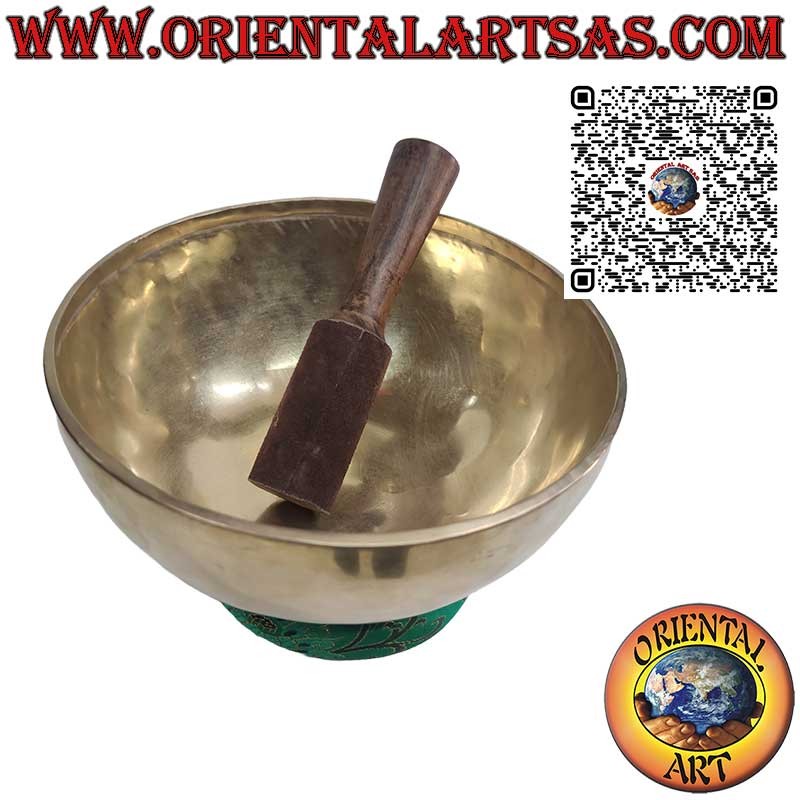

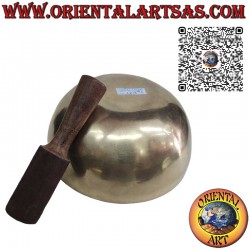
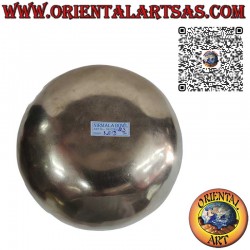
The "Nirmala" Tibetan bell, with a diameter of 24 cm and a weight of 1500 g, is a highly prestigious artisan work, handmade with a precious alloy of seven metals: gold, silver, mercury, copper, iron, tin and lead. Tuned to the note "C" with a frequency of 130 Hz, this bell emits a deep and resonant sound, ideal for stimulating the first chakra, the root one, and promoting a sense of rootedness and stability. The bell produces a powerful, enveloping tone, perfect for deep meditation practices, relaxation and sound therapies. The wooden clapper, often covered in felt, allows you to obtain a soft and rich sound, both by striking and rubbing the edge of the bell. Its generous size and considerable weight give it a robust and enveloping sound quality, making the bell a valuable tool for advanced meditative experiences and yoga practices. Each piece is a testament to Tibetan craftsmanship and spiritual tradition, offering a profound and authentic sound experience.
The Tibetan bell, also known as the "singing bowl", is an ancient musical instrument originating from the bon po Himalayan pre-Buddhist shamanic culture that reigned in ancient Tibet. Later it spread throughout Asia: today they are mostly produced in Nepal (with a very ancient tradition in the Thado region)
The Tibetan bell is composed of seven metal alloys, where each metal in fact refers to a specific planet of the solar system:
Gold = Sun
Silver = Moon
Mercury = Mercury
Copper = Venus
Iron = Mars
Tin = Jupiter
Lead = Saturn
Tibetan bells are typical static or ground bells. Unlike traditional bells, the Tibetan bell is not hung upside down and the clapper is not internal and pendulum-style, but manual and external: the bell is rung by striking it and / or rubbing it with the striker on the outer edge. The sound of these instruments corresponds to a long polyharmonic vibration. This feature has made them widely used for religious purposes, for rituals and meditations, given the psychotropic effect that the vibrating sound has on the human mind. The Tibetan bells produce a pure sound and a harmonic vibration and are therefore used as vibrational instruments. Their origin dates back to about 3 thousand years ago or to a historical phase prior to the birth of Buddhism.
At that time, according to what the legend says, a ritual was practiced that gave gongs, bells and cymbals both the ability to heal the body and the power to bring man closer to divinity. From the second half of the twentieth century this object was also accepted in Western culture and began to be appreciated above all as a therapeutic tool.
The sound produced by a Tibetan bell also depends in part on the metals present in it: however, which is the perfect mixture is still a mystery. The stick used to produce the vibrations is instead of wood, generally covered at the end with chamois leather. The size of this object may vary according to the size of the bell.
Data sheet
The "Nirmala" Tibetan bell, with a diameter of 24 cm and a weight of 1500 g, is a highly prestigious artisan work, handmade with a precious alloy of seven metals: gold, silver, mercury, copper, iron, tin and lead. Tuned to the note "C" with a frequency of 130 Hz, this bell emits a deep and resonant sound, ideal for stimulating the first chakra, the root one, and promoting a sense of rootedness and stability. The bell produces a powerful, enveloping tone, perfect for deep meditation practices, relaxation and sound therapies. The wooden clapper, often covered in felt, allows you to obtain a soft and rich sound, both by striking and rubbing the edge of the bell. Its generous size and considerable weight give it a robust and enveloping sound quality, making the bell a valuable tool for advanced meditative experiences and yoga practices. Each piece is a testament to Tibetan craftsmanship and spiritual tradition, offering a profound and authentic sound experience.